Short answer: Paseo de Montejo is a walk, and you start at the south end. It begins at El Remate, on Calle 47 x 56-A, and the classic stretch runs up to Calle 33; keep going and the avenue ends at the Monumento a la Patria roundabout, where the Prolongación begins. Everything worth seeing is on that one sidewalk.
And one thing almost no guide mentions: the monument the walk ends at was carved by hand — by a Colombian. First things first, though.
Where it starts: El Remate, on Calle 47
El Remate de Paseo de Montejo is the avenue's kilómetro cero, on Calle 47 x 56-A. It's a small plaza with benches and trees, and it's where the city stages Noche Mexicana on Saturdays. Coming from downtown, it's the obvious place to begin: from there north you don't have to cross anything.
We're at Calle 62 #443, between 51 and 53. In the downtown grid that's three streets east and three north — walkable, and all of it still Centro. So when someone asks us on WhatsApp whether they can get to the Paseo from here without a car: yes.
Why Mérida has an avenue like this
The idea dates to January 1888 and came from a group of landowners, industrialists and merchants. The first stone was laid on 5 February that year and the work was finished in 1904. The model was the French boulevard: a wide avenue, trees down both sides, roundabouts — the thing half of Latin America was building at that moment.
The money came from henequen. In the last decades of the 19th century Yucatán boomed on «green gold», and the people who got rich from it built their mansions along this avenue. So Paseo de Montejo isn't a neighbourhood that gradually turned handsome: it's an avenue built on purpose so those houses could be seen.
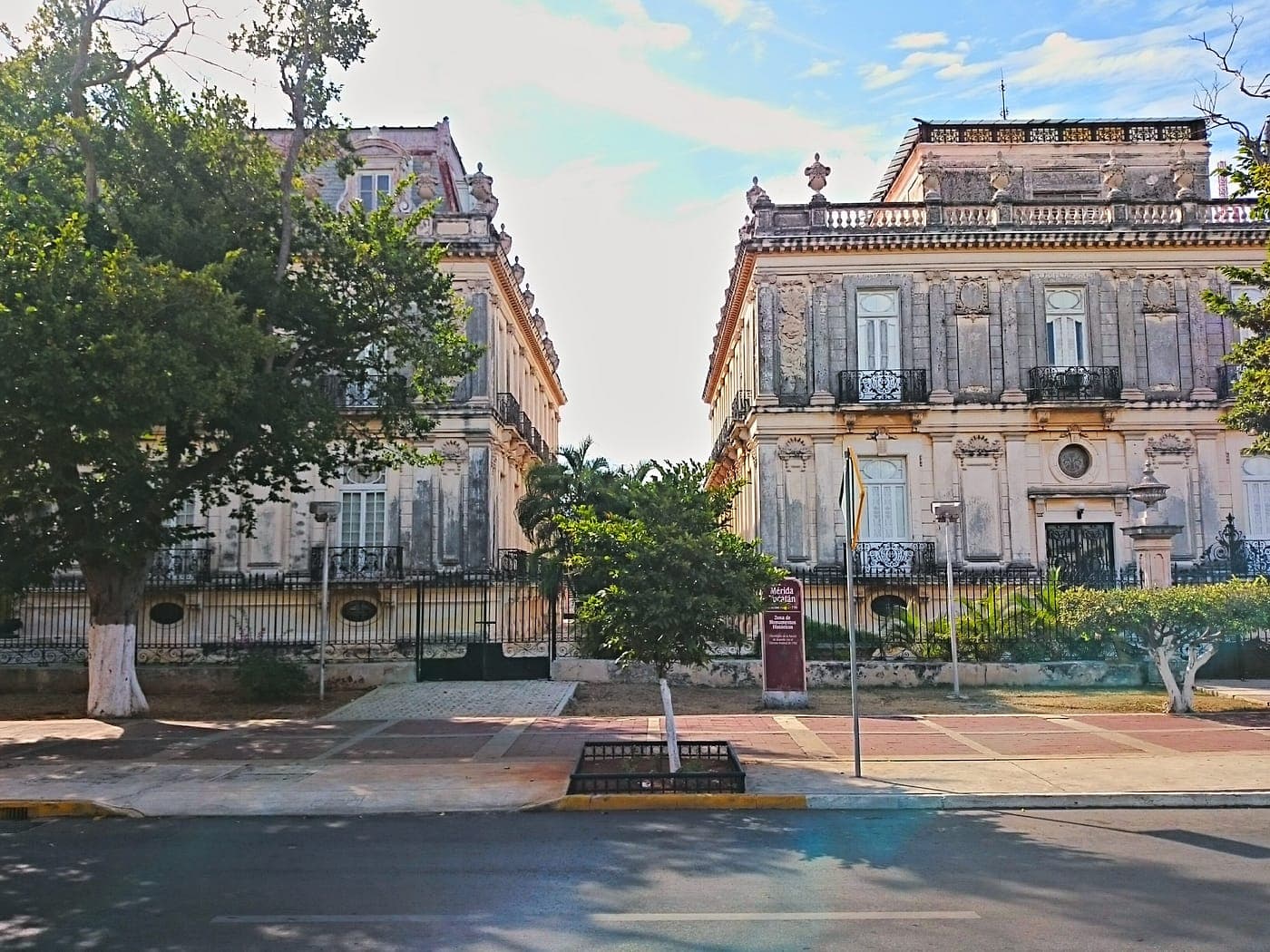
Casas Gemelas, between Calle 43 and Calle 45
These are the two that end up in everybody's photos. Brothers Ernesto and Camilo Cámara Zavala had them built between 1908 and 1911, designed by a French architect trained at the École des Beaux-Arts in Paris, Gustave Umbdenstock, in French Second Empire style. Up close they aren't identical — there are real differences — but at a glance they look it, hence the name.
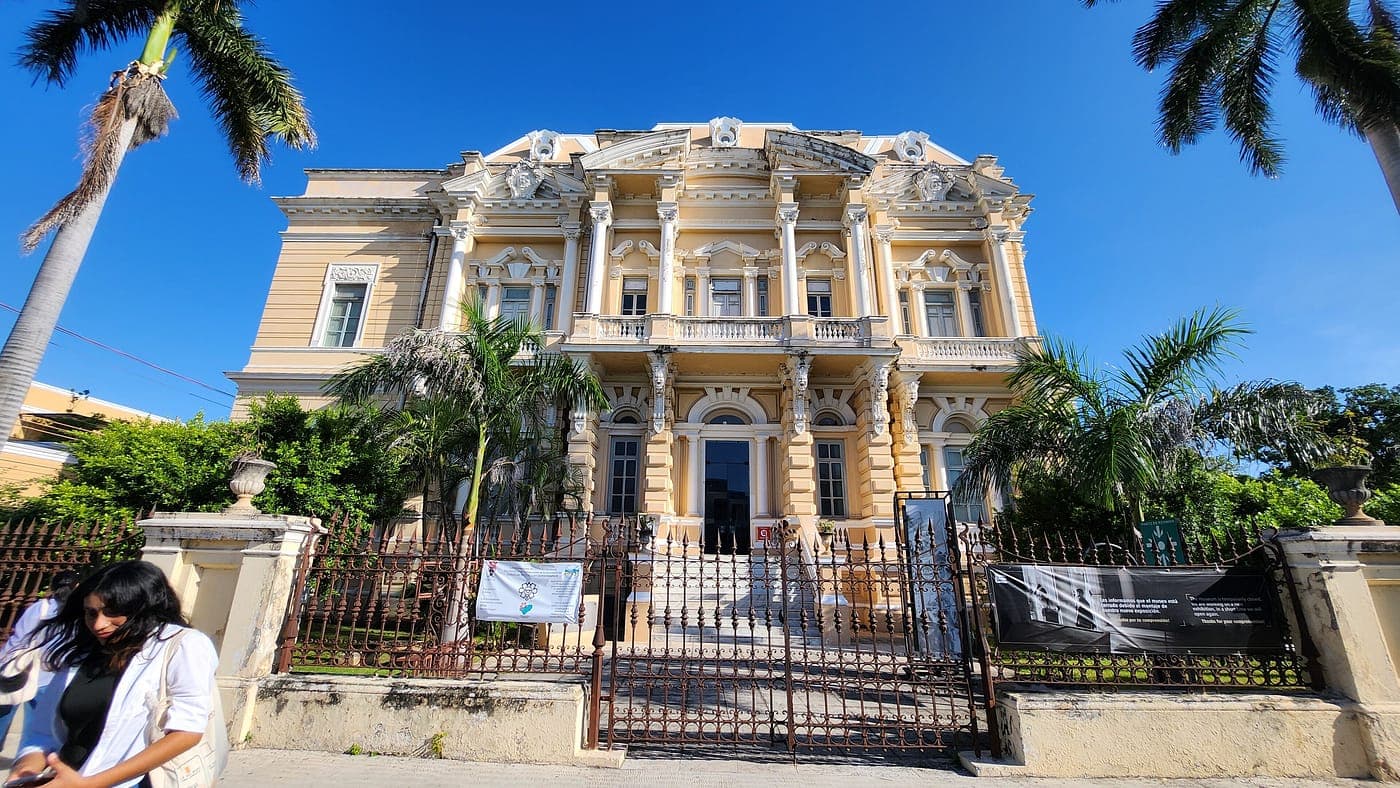
Palacio Cantón, on Calle 43
A little further north, at Paseo de Montejo #485 x Calle 43, stands the Palacio Cantón. It's a Porfiriato-era mansion and today it houses the Museo Regional de Antropología, run by INAH. It's the one you spot from a distance, by the rounded corner and the columns.
There are more houses open to the public along the same avenue — Quinta Montes Molina, and the Casas Gemelas themselves, open since 2021 as Casa-Museo Montejo 495. We don't publish anyone else's opening hours or ticket prices, because they change and ours would quietly go stale: what we can tell you is that they're all on the same paseo, a few blocks apart.
The far end: Monumento a la Patria
The avenue ends at a roundabout, and in the middle of it stands a semicircle of stone 14 metres high and 40 across, carrying more than 300 figures from Mexican history — all carved by hand. Work began on 7 March 1945 and it was inaugurated eleven years later, on 23 April 1956, by president Adolfo Ruiz Cortines. That's where Paseo de Montejo stops and the Prolongación starts.
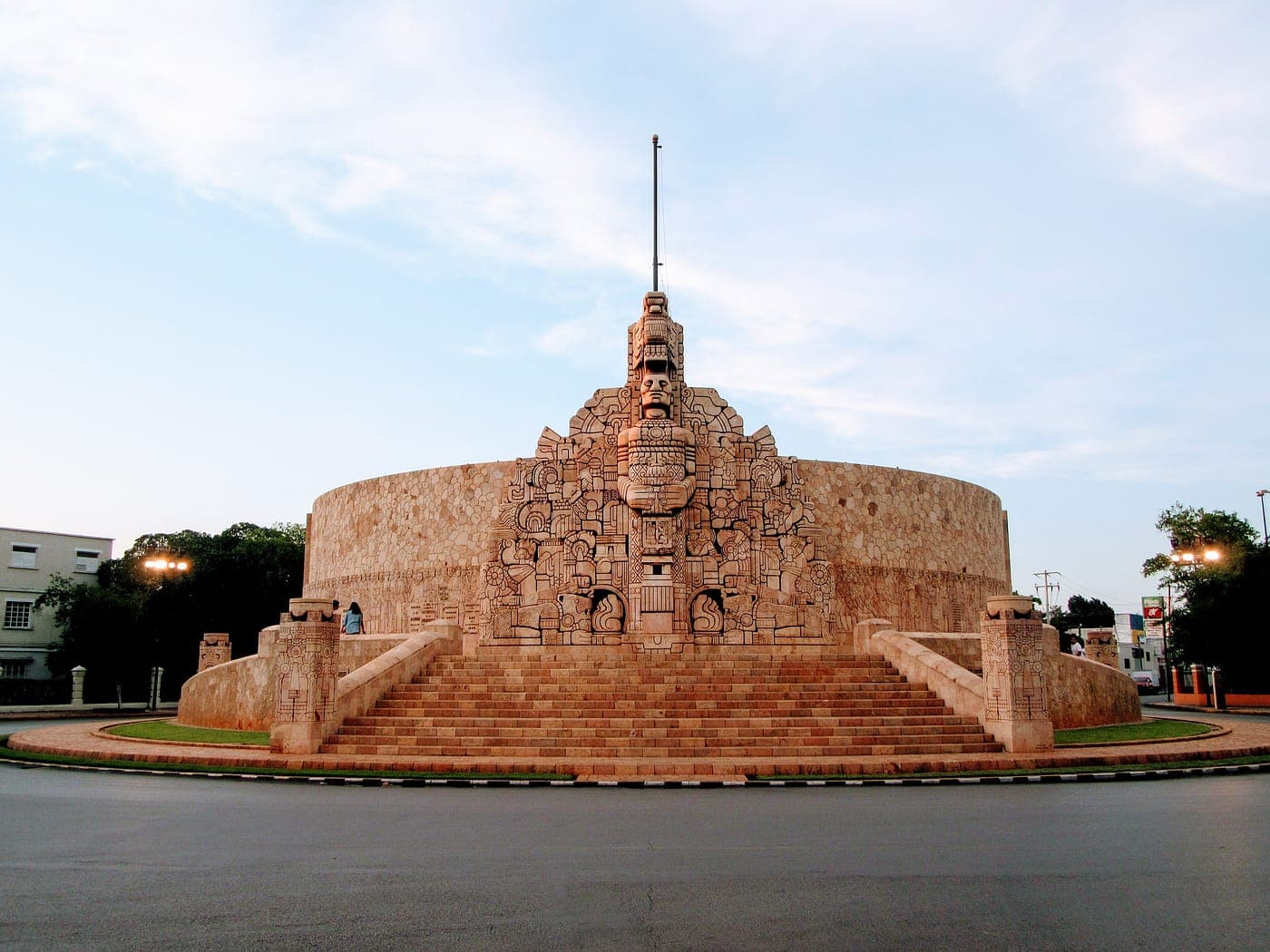
A Colombian carved it, and he's buried underneath
The sculptor was Rómulo Rozo, born in Bogotá in 1899. He came to Mexico in 1929 with the Colombian embassy and ended up in Yucatán in the early 1940s, invited by the state government to teach sculpture. He worked on the monument with architect Manuel Amábilis, but the research and the carving of the figures were his.
He stayed, and he died in Mérida on 17 August 1964. His remains rest in a crypt beneath the monument.
We tell you this because it's close to home and because hardly anyone says it: this city's most photographed landmark was made, stone by stone, by a Colombian who stayed. We've been here a good deal less time, but we come from the same place.
What time of day to walk it
This part isn't from an encyclopaedia, it's what we tell people on WhatsApp: mid-afternoon sun in Mérida is no joke, and the Paseo is wide and fairly open. Early morning, or from six in the evening, is a far better walk — and the houses look exactly the same.
If you can pick your day, Sunday morning is a different walk altogether: the city closes a route through the Centro and Paseo de Montejo to cars for the Biciruta, whose Sunday route runs from the Ermita de Santa Isabel to the Monumento a la Patria. With no traffic, the avenue belongs to whoever is walking it.
The Biciruta and the rest of downtown with kids
And if you're driving in, it's the usual question: where to leave the car. From the downtown parking lots you can walk to the Paseo and to us.
Where to park in downtown Mérida
When you finish the walk
We're a few blocks from El Remate, at Calle 62 #443, next to Parque de Santa Lucía. If you're coming back hungry and want to know what's on before you sit down, the whole menu is on the site.